
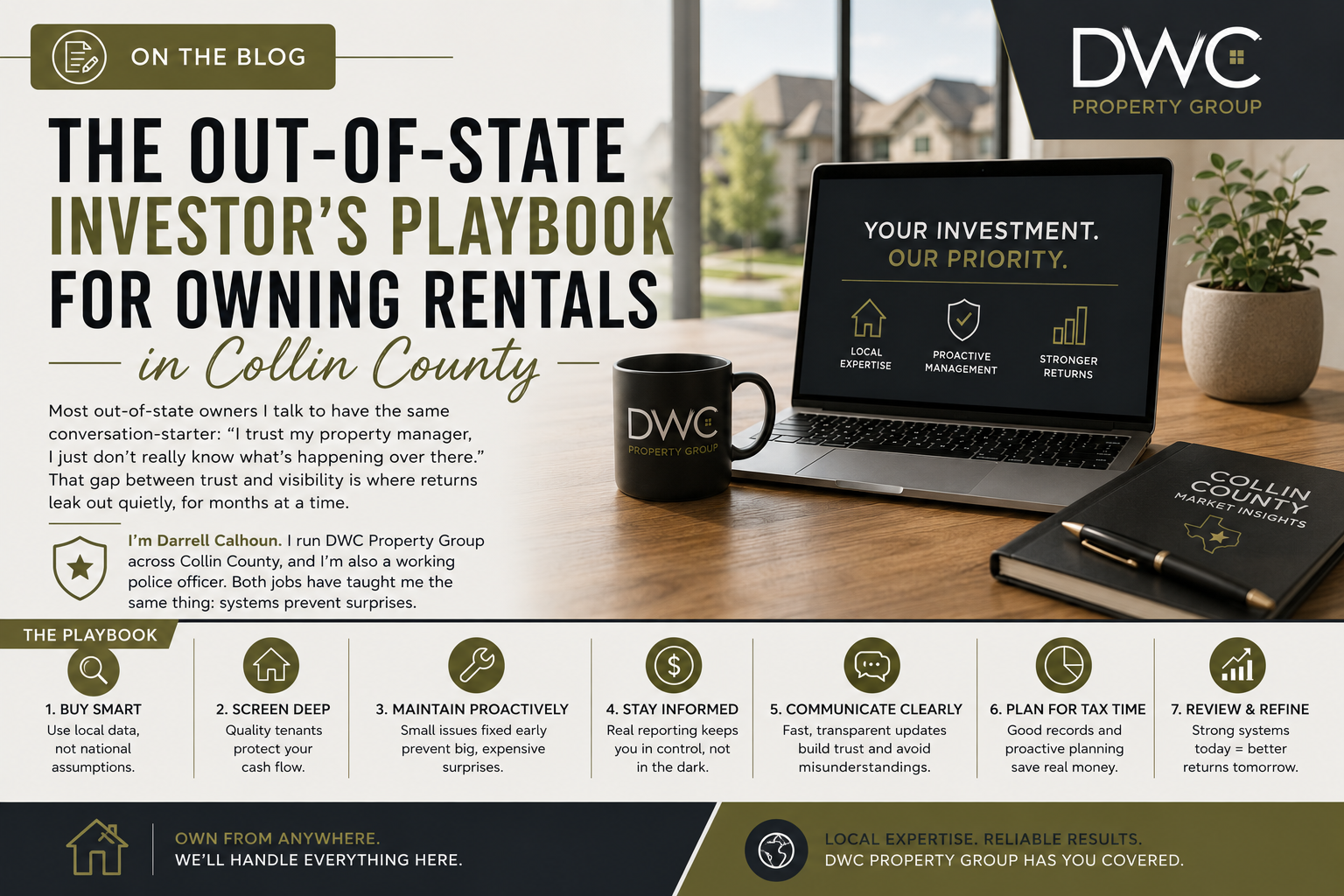
The Out-of-State Investor's Playbook for Owning Rentals in Collin County
Most out-of-state owners I talk to have the same conversation-starter: "I trust my property manager, I just don't really know what's happening over there." That gap between trust and visibility is where returns leak out quietly, for months at a time.
I'm Darrell Calhoun. I run DWC Property Group across Collin County, and I'm also a working police officer. Both jobs have taught me the same thing: systems prevent surprises. If you own a rental in Celina, Frisco, Plano, or anywhere else in the county and you live 1,200 miles away, what follows is the playbook I'd want if I were in your seat.
The "I'll Handle It" Problem
There's a version of property management that sounds like this on every call: "Don't worry, we've got it handled." No detail. No timeline. No documentation.
That's not management. That's a voicemail response.
Real out-of-state investor property management looks like a defined process that runs whether you call or not. It means work orders opened same day, vendor ETAs communicated within 24 hours, and an owner portal where you can pull an invoice at 11 p.m. on a Tuesday without waiting on a callback. If your current manager can't describe their process in specific steps, you don't have a process. You have a person.
The difference matters most when something goes wrong. A $400 HVAC fix handled fast stays $400. The same fix ignored for two weeks becomes a $2,200 coil replacement and a tenant threatening to break the lease.
Building the Vendor Network Before You Need It
The single biggest operational risk for a remote owner is having no pre-qualified vendor when a 10 p.m. emergency call comes in. Every property manager will say they have "trusted vendors." The question is whether those vendors are under a documented agreement with defined response windows, or just a name in someone's phone.
At DWC, our vendor relationships include defined priority tiers. Emergency items (no heat, no water, active leak) require contact within 2 hours and a scheduled repair within 24. Routine items get scheduled within 5 business days. Every vendor we use carries minimum liability coverage, and we verify it before the first job.
For a Union Park home in Aubrey or a property inside Phillips Creek Ranch in Frisco, we're not dispatching the same plumber who works 40 minutes away if there's a closer, qualified option. Geography matters for response time. Response time matters for tenant retention. Tenant retention is the number that protects your annual return more than any other single variable.
If you want to stress-test a property manager before you sign, ask them: "What happens at 2 a.m. on a Saturday when the water heater fails?" If they can't walk you through a specific, documented process, that's your answer.
For a deeper look at how maintenance systems protect cashflow, I wrote a full breakdown here: rental property maintenance systems that actually work.
Inspection Cadence: How I Know What You Can't See
You can't drive by. That's fine. Drive-bys are actually a poor substitute for a structured inspection.
Here's the inspection cadence we run for out-of-state owners:
- Move-in inspection: Full photographic documentation with time-stamped photos at lease start. This is your legal baseline.
- 6-month inspection: Interior walkthrough, condition report, any deferred maintenance flagged with cost estimates.
- Annual inspection: Full interior and exterior. HVAC filter check, water heater visual, appliance function test, smoke and CO detector verification.
- Move-out inspection: Compared line-by-line against the move-in report. This is how deposit disputes get resolved cleanly.
In our portfolio, owners who receive a 6-month inspection report almost never have a costly surprise at move-out. Owners who skip mid-lease inspections sometimes discover $8,000–$12,000 in deferred damage that built up invisibly over two years. I've seen it happen in otherwise solid neighborhoods like Mustang Lakes in Celina, where a home looked great from the curb the whole time.
Every inspection report is uploaded to the owner portal within 48 hours. You don't have to ask.
Accounting Transparency: What You Should Actually See Each Month
A monthly owner statement should answer four questions without any translation required:
- What rent came in, and when?
- What was paid out on my behalf, and to whom?
- What is my current reserve balance?
- Are there any open items I need to approve?
Most statements I've reviewed from other managers answer question one and vaguely gesture at question two. Questions three and four are an afterthought.
At DWC, every line item on the statement includes the vendor name, invoice number, and a one-sentence description of the work. If I paid $185 for a plumbing call at a Light Farms property, you see exactly that on your statement — not a generic "maintenance expense." Copies of the invoice are attached directly in the portal.
Owner distributions go out on the 10th of each month, assuming rent is collected. If a tenant pays late, I tell you before the 10th, not after you notice the deposit is short. That's just how it should work.
Texas Property Tax: What Out-of-State Owners Get Wrong
Texas has no state income tax, which is one reason out-of-state investors are drawn here. But property taxes are real, and they run higher than most states.
A few things remote owners routinely miss:
Homestead exemption does not apply to rental properties. If you converted your former primary residence to a rental and forgot to remove the homestead exemption, you are receiving a benefit you're not legally entitled to. That creates back-tax exposure. Fix it now.
Protest your assessed value every year. Collin County Appraisal District resets values annually, and assessed values in fast-growing areas have climbed sharply since 2021. In my experience, owners who protest consistently save $800–$1,500 per year on a single-family property. It is worth the 30 minutes.
1099s ship by January 31. If you use a property manager, you should receive your 1099-MISC by that date. We deliver owner 1099s by January 25 to give your CPA margin. If your manager is still sending tax documents in mid-February, that's a paperwork operation problem.
Cost segregation and depreciation are tools worth discussing with a CPA who handles real estate investors specifically. Texas rental income is still subject to federal income tax, and proper depreciation scheduling on a $450,000 Collin County property can create meaningful annual deductions.
Communication SLAs: What You Should Expect, in Writing
"We'll keep you in the loop" is not a service level agreement. Here's what an actual SLA looks like for remote owners:
| Event Type | Expected Response |
|---|---|
| Maintenance request received | Owner notified within 24 hours if repair exceeds $300 threshold |
| Emergency repair | Owner notified same day, action taken regardless of approval |
| Lease renewal offer sent to tenant | Owner notified 90 days before lease expiration |
| Tenant delinquency (day 4) | Automated late notice sent; owner alerted |
| Tenant delinquency (day 10) | Owner consulted on escalation path |
| Lease violation notice | Owner receives copy within 24 hours of filing |
At DWC, these are documented in the management agreement. Not verbal promises. If something falls outside this table, you get a call or a portal message from me directly.
One thing I tell every new out-of-state client: pick your preferred communication channel and hold your manager to it. Some owners want a weekly email summary. Some want to live in the portal and only hear from me if something is unusual. Both are fine. What's not fine is radio silence for 45 days.
Picking the Right Collin County Market Before Any of This Matters
All the systems above assume you've bought in the right place. Out-of-state investors sometimes buy on price alone and end up with a property in a zip code where rent-to-price ratios won't support the return they modeled.
I've written a full neighborhood breakdown at best Collin County neighborhoods for rental returns. The short version: master-planned communities are the most defensible long-term holds. Look for strong school ratings and sub-5% vacancy.
And before you place a tenant in any of those properties, the screening process is what separates a two-year cashflow story from a six-month eviction story. I broke down tenant screening in Texas with actual numbers in a separate post — worth reading before your next lease.
The Bottom Line for Remote Owners
Owning a Collin County rental from out of state is completely workable. I manage properties for owners in California, Colorado, New York, and a handful of other states. The common thread among the ones who sleep well at night: they chose a manager who could explain their process, not just promise results.
If you want to talk through what management would look like for your specific property, reach out directly. No sales pitch. Just a straight conversation about whether we're the right fit.
Frequently Asked Questions
Can I own a rental property in Texas if I live in another state?
Yes, and Texas is one of the more investor-friendly states for remote ownership. There's no state income tax on your rental income, though federal income tax still applies. You'll want a licensed property manager handling the day-to-day, and you'll need to stay current on Collin County Appraisal District notices, especially around annual tax assessments.
How do out-of-state investors typically manage their Collin County rentals?
Most remote owners work with a local property management company that handles leasing, maintenance coordination, rent collection, and tenant communication. The best setups include an online owner portal with real-time access to financials, inspection reports, and work orders. I've seen owners try the self-manage route from out of state; it usually works until the first maintenance emergency or tenant dispute, then it doesn't.
What do I need to know about Texas property tax as an out-of-state owner?
Property taxes in Collin County are meaningful, typically 1.8%–2.4% of assessed value depending on the city and school district. Rental properties do not qualify for homestead exemptions. Annual value protests are worth filing. In my experience, consistent protests save owners $800–$1,500 per year on a typical single-family rental. Your 1099 from your property manager should arrive by January 31.
How often should my property manager send me reports?
At minimum, a monthly owner statement covering rent collected, expenses paid, and reserve balance. Quarterly inspection reports are reasonable; twice a year is what we run. Any maintenance item above your pre-agreed approval threshold should trigger an immediate notification. If you're only hearing from your manager when rent posts, that's not enough contact.
How do I know my rental is actually being maintained when I can't drive by?
Time-stamped, photographic inspection reports uploaded to your portal are the baseline standard. At DWC, we run move-in, 6-month, annual, and move-out inspections. Every report is in your portal within 48 hours. Work orders also include vendor notes and, when relevant, before-and-after photos. A drive-by is a poor substitute for a documented inspection with photos and a written condition summary.
What communication response times should I expect from my property manager?
For maintenance requests above the dollar threshold, 24-hour notification is reasonable. For emergencies, same-day. For lease renewals, 90-day advance notice before expiration. For delinquency, notification by day 4 or 5 of non-payment. These should be written into your management agreement, not left as informal expectations.
Author
Darrell Calhoun Owner DWC Property Group
Darrell Calhoun is the Owner of DWC Property Group and founded the company based on firsthand experience as a real estate investor and rental property owner. After owning and managing several rental properties, Darrell repeatedly encountered a common frustration within the industry: management fees being charged without clear explanations or work being completed. As an owner, it was often unclear what those fees represented, why they were necessary, or how they truly benefited the property or the resident. That experience became the catalyst for creating DWC Property Group. Darrell set out on a mission to build a property management company rooted in transparency, accountability, and clarity—where every fee has a defined purpose, every charge is documented, and all costs make sense to both owners and tenants. This commitment to transparency is the cornerstone of the company's mission. In addition to his real estate and property management background, Darrell is a police officer. His law enforcement experience has heavily influenced how the company operates, emphasizing discipline, risk mitigation, documentation, and calm decision-making under pressure. These principles are embedded into DWC Property Group's culture and daily operations.