
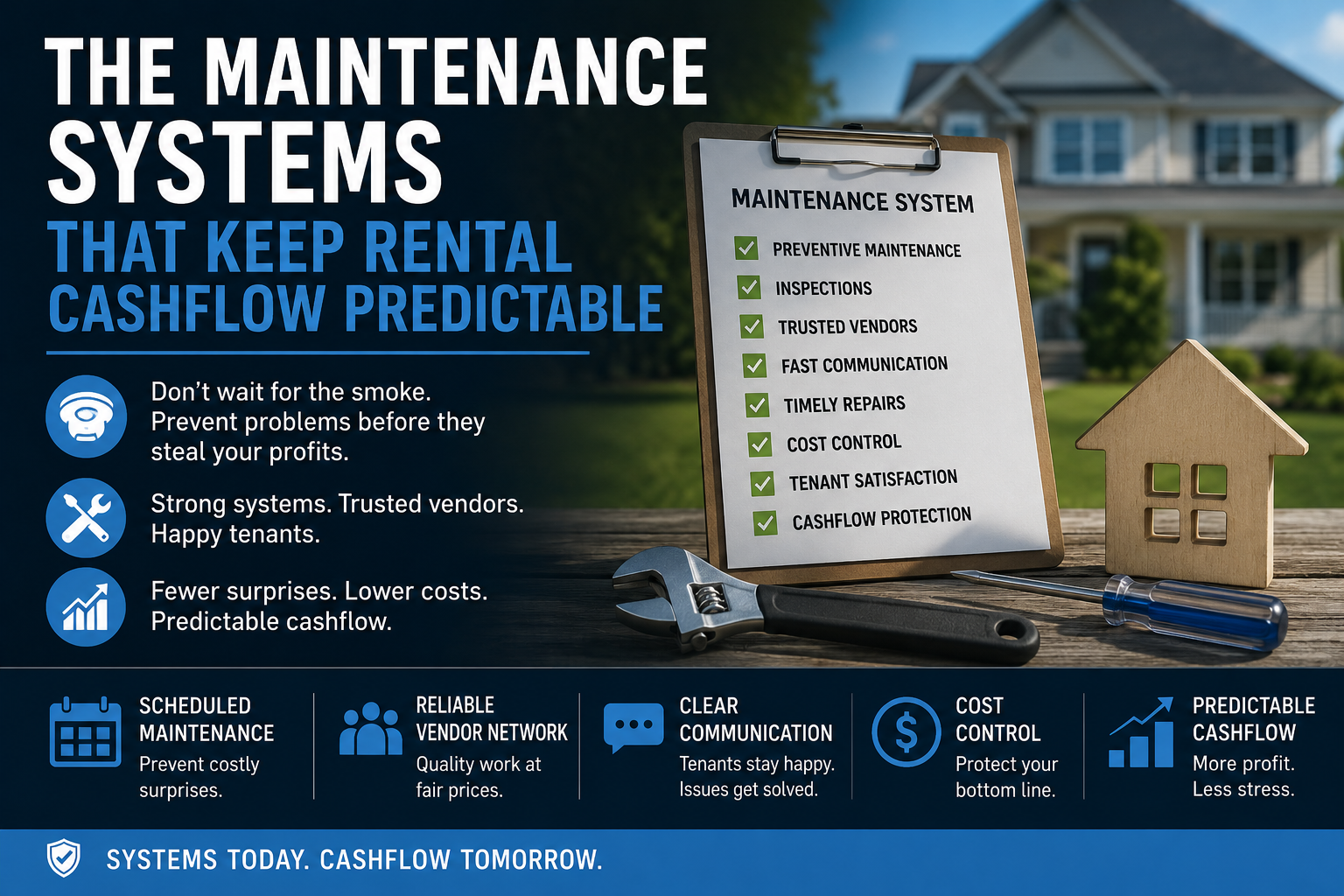
The Maintenance Systems That Keep Rental Cashflow Predictable
Most landlords treat maintenance like a smoke alarm: they ignore it until something is on fire. Then they scramble for a vendor, overpay on a rushed repair, lose a week of rent, and wonder why their cashflow looks worse than the spreadsheet said it would.
I've been running rentals in Collin County long enough to know that maintenance is where most self-managing landlords lose the money they thought they were making. The fix isn't magic. It's a system. Here's the one we use.
Work Orders Need a Defined Routing Path, Not a Phone Number
The first thing I built was a work-order routing system with exactly three tiers.
Tier 1 (under $300): Tenant submits via the portal. We dispatch a pre-approved vendor within 24 hours. No owner call needed. This covers things like dripping faucets, running toilets, and tripped breakers.
Tier 2 ($300–$1,500): We source at least two bids, present options to the owner within 48 hours, and dispatch once approved. We target a resolution call within 72 hours of the original ticket.
Tier 3 (over $1,500): Full documentation before any work starts. Photos, written scope, bid comparison, and owner sign-off. No exceptions.
That tiered structure matters because it eliminates the two worst failure modes: tenants waiting days for a dripping faucet fix (which breeds resentment and turnover) and owners getting blindsided by a $4,000 HVAC replacement they didn't know was coming.
The Tier 1 authority limit is the piece most property managers skip. Without it, every small repair becomes a two-day phone tag exercise. Tenants stop reporting small problems. Small problems become expensive ones.
The number that moved me: In our portfolio, roughly 68% of all work orders fall under $300. Routing those automatically, without an owner call, saves an estimated 4–6 hours of management time per property per year — time that goes back into pricing, leasing, and inspections.
Vendor Accountability Is Not a Relationship. It's a Scorecard.
I hear property managers talk about their "trusted vendor network" all the time. That phrase usually means they call the same three guys they've known for years and hope for the best.
I run it differently. Every vendor in our approved pool gets scored on four metrics after each completed job: response time, work quality (scored on a 1–5 scale by the tenant and the site inspector), invoice accuracy, and callback rate (how often the same issue comes back within 60 days).
A vendor who scores below a 3.5 average over any rolling 90-day window gets removed from the primary dispatch list. They move to backup only, or off entirely. This is the same accountability logic I use in law enforcement: you document, you measure, you act on the data.
For owners in Prosper and Celina, this matters more than it might in a slower market. Tenant expectations in master-planned communities like Windsong Ranch or Light Farms are high. These residents pay premium rents. They expect premium responsiveness. A vendor who ghosts a ticket for three days is costing you a renewal, not just an afternoon.
If you're a self-managing landlord making common mistakes, vendor accountability is almost always one of them. It's hard to fire a vendor you've used for years. Do it anyway if the scorecard says so.
The 12-Month Preventative Maintenance Calendar
Reactive maintenance costs two to three times more than preventative maintenance. That's not an opinion. It's what happens when a $12 HVAC filter replacement turns into a $3,800 compressor swap because the filter ran dirty for 14 months.
Here's the calendar we follow across our Collin County portfolio:
| Month | Task |
|---|---|
| January | Test smoke/CO detectors; inspect attic insulation |
| February | HVAC filter swap; check weatherstripping on all exterior doors |
| March | Inspect roof and gutters post-winter; test irrigation system before warm season |
| April | Full HVAC service (before cooling season); re-caulk tubs and showers if needed |
| May | Check exterior paint and trim for cracking or peeling |
| June | Flush water heater; check pressure relief valve |
| July | Inspect attic for heat-related issues; clean dryer vents |
| August | Test GFCI outlets; check window seals |
| September | Pre-winter HVAC service; inspect chimney if applicable |
| October | Clean gutters; check exterior caulking and foundation drainage |
| November | Winterize exterior faucets; test all interior plumbing fixtures |
| December | Full interior inspection; document any tenant-caused damage before lease renewal |
This is a living schedule. In a new-build community like Trinity Falls in McKinney, the first two or three years skew lighter because the mechanical systems are under builder warranty. Once you're past year three, the calendar gets heavier. Plan for it.
A rental property maintenance schedule is only useful if someone is actually accountable for running it. In our system, each property has a named inspection lead and a scheduled date on the calendar by January 1 of each year. It doesn't slip because it's already blocked.
Reserve Funds: The Number Most Owners Get Wrong
The most common question I get from new owners is some version of: "How much should I keep in reserve?"
The standard advice is 1–2% of property value per year. On a $450,000 home in Celina, that's $4,500–$9,000. That range is too wide to be useful, so here's how I actually think about it.
For a property under five years old in good condition, I target 1% of value annually as the maintenance reserve baseline. For a property over ten years old, especially one with original HVAC equipment, I push that to 1.5–2%. If the roof is within five years of its end-of-life, I add a separate line item for a roof reserve, typically $150–$200/month set aside until replacement.
The reserve math on a $475,000 Collin County rental: At 1%, you're setting aside $395/month. At 1.5%, it's $594/month. The difference between those two numbers is what separates owners who handle a $6,000 HVAC replacement without stress from owners who call me in a panic asking whether they can defer it until "after the holidays."
For out-of-state investors managing property in Collin County, reserve discipline is the single biggest operational risk I see. When you're not local, a deferred repair can sit undetected for months. A well-funded reserve removes the incentive to defer.
One more note: keep the reserve account separate from your operating account. Not in the same savings account with a mental note. A different account, labeled clearly. When the HVAC invoice comes in, you pull from the reserve. When the year ends clean, you roll the balance forward.
HOA Properties Add a Layer (and Most Owners Miss It)
A significant portion of Collin County rentals sit inside HOA-governed communities. Light Farms, Windsong Ranch, Star Trail, Phillips Creek Ranch — the list is long. HOA maintenance standards create a compliance obligation that overlaps with your standard rental property maintenance system.
The problem I see repeatedly: an owner gets an HOA violation notice for landscaping, exterior paint, or fence condition. The tenant either didn't know they were responsible or simply ignored it. The fine accrues. The owner finds out 60 days later when the violation is escalating.
Our protocol is simple. Any HOA violation notice gets logged in the work-order system the same day it's received. We contact the tenant within 24 hours, establish who is responsible for the correction based on the lease, and document the resolution before the HOA deadline. If the issue is owner-responsibility (fence repair, exterior paint), we dispatch from the vendor pool immediately.
There's a full breakdown of how this plays out across North Texas communities in the article on HOA violations on rental properties. Read it before your first HOA notice arrives, not after.
Make Maintenance a Budget Line, Not a Surprise
The owners who stress least about maintenance are the ones who treat it like a fixed operating expense. They budget for it in January, fund the reserve monthly, run the calendar, and let the system absorb the hits.
The owners who stress most are the ones who expect every month to be a zero-maintenance month and then spiral when the water heater goes out in October.
Maintenance will happen. The question is whether you meet it with a system or with a panic. If you want a straight look at what your Collin County rental should be budgeting for, start with a free rental analysis and I'll walk you through the actual numbers for your property.
Frequently Asked Questions
How much should I budget for rental property maintenance per year? The standard baseline is 1% of property value annually. On a $450,000 Collin County rental, that's $4,500. For properties over 10 years old or with aging mechanical systems, push that to 1.5–2%. Budget it monthly, not as a lump sum, so the reserve builds before you need it.
What's a typical maintenance reserve for a single-family rental? For a newer build (under 5 years), $300–$400/month covers most owners comfortably. For older properties, $500–$700/month is more realistic. Keep the reserve in a separate account from your operating funds so you're never tempted to defer a repair because the money "isn't there."
Should the tenant or landlord pay for HVAC filter changes? It depends on your lease. In our leases, filter changes are a tenant responsibility (we specify a change interval, typically every 60–90 days). We conduct semi-annual inspections and document filter condition. If a tenant neglects it and causes equipment damage, the repair cost can be charged back under the lease. Get this in writing before move-in.
How often should a rental property be inspected? Twice per year is the minimum. I do a formal documented inspection at the 6-month mark and again at the 11-month mark (before renewal decisions). In HOA communities like Windsong Ranch or Light Farms, I also do a quick exterior pass after any HOA violation window closes to confirm resolution. Move-in and move-out condition reports are separate from this schedule.
What preventative maintenance actually pays for itself? HVAC servicing, dryer vent cleaning, water heater flushing, and roof and gutter inspection are the top four. Each costs $75–$300 per visit and regularly prevents repairs that run $1,500–$8,000. In North Texas, HVAC and roof are non-negotiable given the heat load and storm exposure. In my portfolio, consistent preventative maintenance reduces emergency work orders by roughly 40% compared to reactive-only management.
Does a preventative maintenance schedule reduce tenant turnover? Yes, directly. Tenants in well-maintained homes renew at higher rates. In communities like Trinity Falls or Windsong Ranch, where tenants are paying $2,400–$3,200/month, they expect the property to function well. A tenant who submits three unreturned work orders in year one is gone at lease end. One vacancy in a year often costs more than a full year of preventative maintenance.
Author
Darrell Calhoun Owner DWC Property Group
Darrell Calhoun is the Owner of DWC Property Group and founded the company based on firsthand experience as a real estate investor and rental property owner. After owning and managing several rental properties, Darrell repeatedly encountered a common frustration within the industry: management fees being charged without clear explanations or work being completed. As an owner, it was often unclear what those fees represented, why they were necessary, or how they truly benefited the property or the resident. That experience became the catalyst for creating DWC Property Group. Darrell set out on a mission to build a property management company rooted in transparency, accountability, and clarity—where every fee has a defined purpose, every charge is documented, and all costs make sense to both owners and tenants. This commitment to transparency is the cornerstone of the company's mission. In addition to his real estate and property management background, Darrell is a police officer. His law enforcement experience has heavily influenced how the company operates, emphasizing discipline, risk mitigation, documentation, and calm decision-making under pressure. These principles are embedded into DWC Property Group's culture and daily operations.